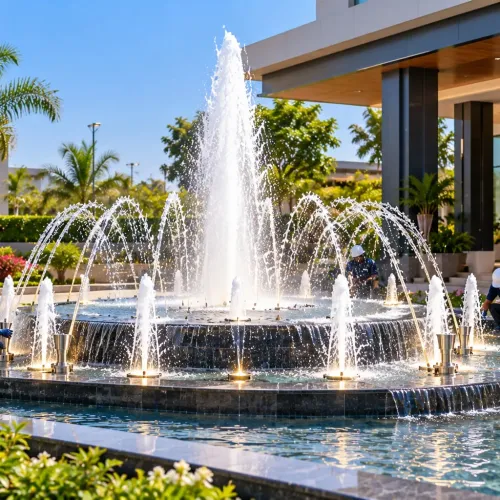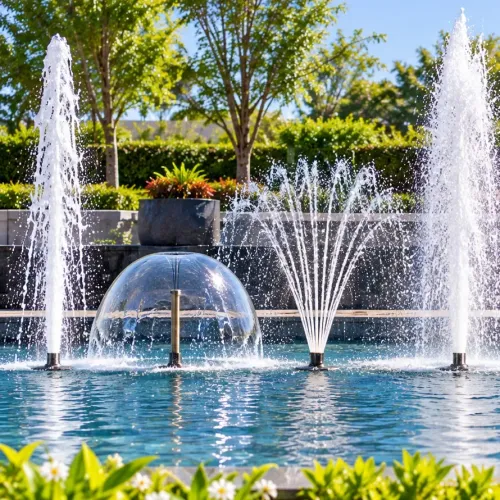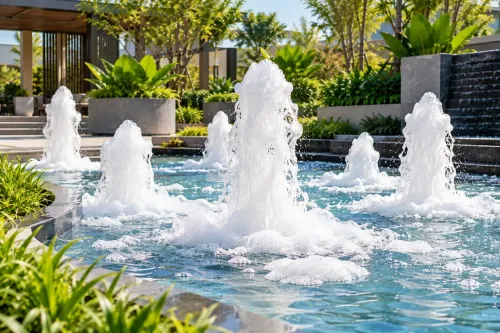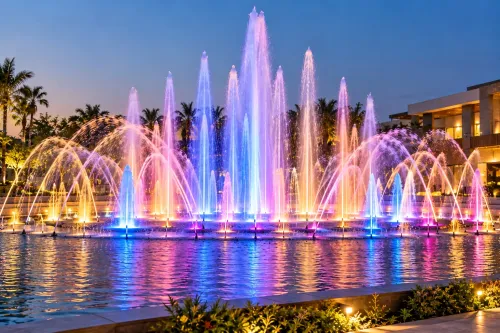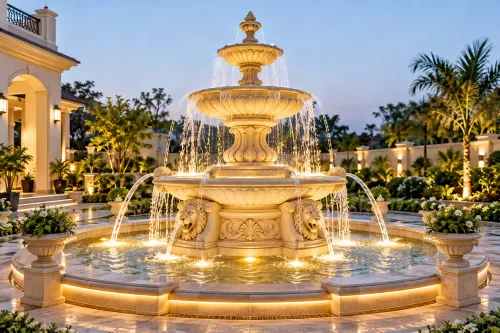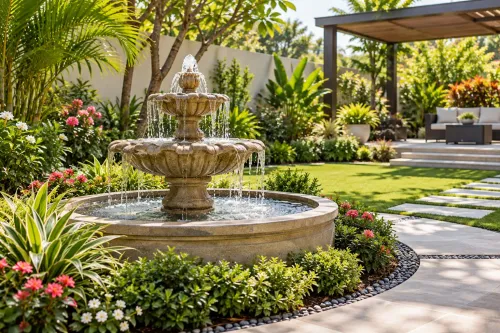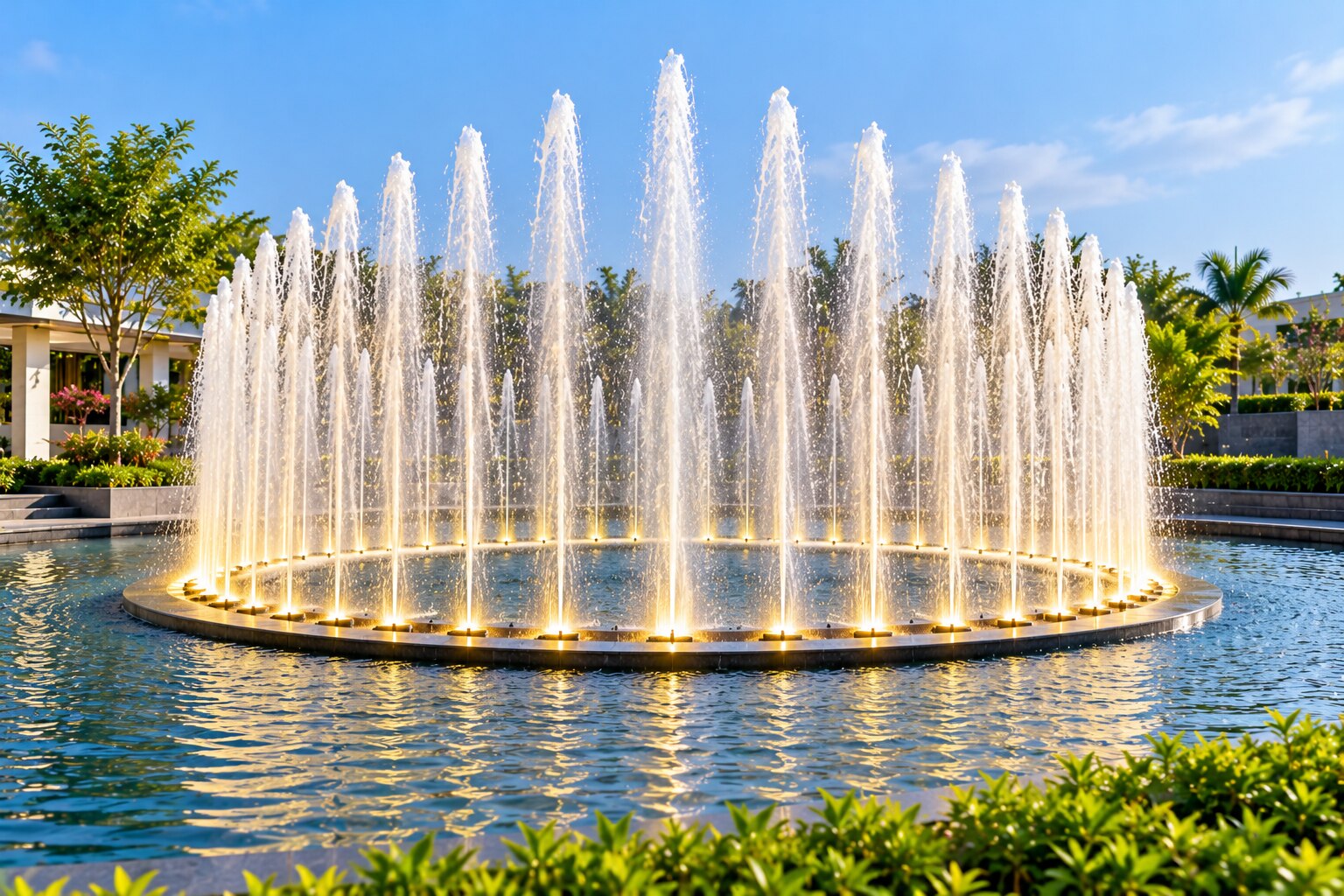
A successful ring fountain is proportioned around its setting, not assembled from a standard ring and pump. You will be able to choose the ring geometry, jet style, hydraulic duty, basin dimensions and maintenance provisions needed for a stable display that suits its site.
Key takeaways
- Set ring diameter against viewing distance and splash-control setbacks.
- Choose jet height and style according to wind exposure and sound goals.
- Balance pump flow across the ring manifold before fixing nozzle spacing.
- Reserve plant-room space and maintenance access during concept design.
Choose Ring Proportions for the Viewing Distance
Choose the ring diameter from the clear water area and the nearest viewing line: leave enough edge setback to contain splash, yet make the pattern large enough to read from the main approach. These starting proportions suit different settings:
| Intent | Ring diameter | Ring count | Nozzle spacing | Centre-jet height |
|---|---|---|---|---|
| Calm garden symmetry | One broad ring within the basin | One ring | Leave clear gaps between jets | Equal to or slightly above the ring jets |
| Plaza focal display | Moderate diameter with a visible centre | Two concentric rings | Closer spacing for a continuous visual rhythm | About 1.25 to 1.5 times the outer-ring height |
| Small pool or courtyard | Compact ring sized to the nearest sightline | One ring, or two only if the basin is wide | Keep individual streams visibly separate | Low enough to prevent overspray |
Set nozzle spacing from the jet diameter at its display height and the viewing distance, not from symmetry alone. If adjacent streams merge from the closest viewpoint, increase the spacing; if the ring looks broken from the main approach, reduce it or use a fuller jet.
A larger ring count adds depth but also increases flow, manifold losses and maintenance points.
Check the ring proportions from standing eye height, the main pedestrian approach and the farthest expected viewpoint. Keep the centre jet inside the basin during wind, and specify removable nozzle inserts, isolation valves and strainer access before fabrication; small outlets can foul long before the pump shows a fault.
Match the Jet Style to Wind, Sound and Visual Intent
Choose smooth-stream jets for a quiet, precise ring; choose aerated jets when you want volume and movement. The right choice depends on wind exposure, acceptable sound, splash tolerance and whether the fountain is a calm boundary or a dramatic focal point.
| Jet type | Appearance and sound | Operating behaviour | Best fit |
|---|---|---|---|
| smooth-stream jets | Clear, glass-like arcs with minimal sound | Sensitive to turbulence, air entrainment, blocked strainers and damaged nozzle edges; wind can bend the stream | Sheltered gardens, formal courtyards and quiet entrances |
| flower jets | Petal-like sprays with a recognisable pattern and moderate sound | Produces more droplets and splash than a clear stream; pattern degrades when nozzles sit unevenly | Decorative rings where texture matters more than silence |
| foam jets | Dense, white, bubbly columns with strong visual volume and louder water noise | Shorter, heavier-looking output; splash is obvious and wind can scatter the crown | Feature displays viewed from a distance |
| aerated jets | Bright, white streams with increased apparent height and volume | Smaller droplets increase drift and evaporation, making them vulnerable to crosswinds | Sheltered focal features, not exposed plazas |
In a windy location, reduce trajectory height, widen the sheltered zone, add wind shutoff logic or increase outlet spacing before selecting a larger pump. A taller aerated jet usually creates more drift, not better visibility.
Keep the basin level within a controlled operating range. Evaporation, splash-out and makeup-water events change nozzle pressure, so jet height can drift even when pump speed stays constant. A level controller and correctly sized overflow preserve the intended pattern.
Size the Pump and Balance the Ring Manifold
Pump selection starts with the total nozzle discharge, not the ring diameter. For a fixed nozzle, flow rises with the square root of pressure, while ideal jet height rises almost directly with pressure. A small pressure difference can therefore create noticeably different jet heights even when the flow difference seems minor.
Build the ring fountain pump sizing duty point from these inputs:
- Nozzle count and selected orifice diameter, which establish total pump flow
- Required jet height, which establishes nozzle pressure
- Elevation between the pump and nozzles
- Friction loss through the manifold, bends, valves and fittings
- Pressure loss through the strainer, filter at its dirty condition and treatment equipment
The selected pump must deliver the required pump flow at the combined pump pressure and system losses. Sizing it only at the nominal nozzle flow, or against a clean filter, can make the outer jets collapse as the filter loads.
A single inlet at one point does not guarantee equal-height jets. Water pressure falls along the header as outlets discharge, so nozzles near the inlet can throw higher than distant nozzles. Manifold balancing reduces that difference through a centre feed, dual feed, hydraulic zones or individually sized outlet orifices.
Keep the layout serviceable. Removable nozzle inserts, isolation valves, drain-down access and reachable strainers matter because scale and biological growth can block small passages before the pump shows a fault. A variable-speed pump also lets you adjust the ring pattern efficiently; reducing speed usually wastes less energy than throttling a constant-speed pump.
Plan the Basin, Plant Room and Maintenance Access
Fix the fountain basin dimensions, operating water depth and service routes before any ring, liner or pipework is fabricated. The drawing must show the ring centre, wall setbacks, slab falls, drain sump, overflow level and access covers, not just the plan-view circle.
1. Set the basin length and width from the ring’s outside diameter, edge clearance and viewing-side safety zone. Confirm the finished waterline and operating water depth at normal, low and high levels; level changes alter nozzle pressure and jet height.
2. Detail water-level controls: a makeup-water valve or float assembly, a visible low-level cut-out, and an overflow sized for makeup failure, splash and heavy inflow. Connect overflow and drainage to a trapped, serviceable outlet, with drain-down capacity that does not flood the equipment room.
3. Reserve equipment-room space around the pump, filter, strainer, treatment units and valves. Draw a clear working aisle of at least 900 mm in front of serviceable components, plus enough vertical clearance to remove the filter lid, motor or cartridge without dismantling fixed pipework.
4. Provide isolation valves for the pump, ring manifold, treatment loop and makeup line. Use removable nozzle inserts and accessible strainers; small outlets can block with scale or biological growth while the pump still runs normally.
5. Add lockable access covers, lifting points, lighting, ventilation, floor drainage and a safe route for removing wet components. For public or interactive installations, verify local health, accessibility and electrical rules, including bonding, grounding and ground-fault protection before construction.
Turn the Concept into a Fabrication-Ready Design Brief
Approve the ring fountain only when the fountain manufacturer has turned the concept into a signed ring fountain design brief, coordinated drawings and a maintenance plan. The package must show what will be built, how it will operate and who can safely service it.
1. Confirm scaled plan and section drawings against site measurements: ring diameter, basin depth, edge setbacks, pedestrian clearances, viewing height, plant-room access and overflow route. Require nozzle count, spacing, elevations, centre-jet height and splash limits.
2. Specify the wetted materials, not just “stainless steel.” Choose stainless steel 304 for ordinary treated water and stainless steel 316 when chloride exposure includes saline water, de-icing salt or coastal spray. Ask how weld discoloration, crevices and splash zones will be finished and protected; 316 still needs those details.
3. Request the hydraulic design: pump duty point, strainer size, isolation valves, drain-down points and manifold feeding arrangement. Confirm how the design controls pressure loss and equalises jet height through centre-feeding, dual-feeding, hydraulic zones or outlet sizing.
4. Put maintenance into the drawings. Removable nozzle inserts, accessible strainers and cleanable channels prevent small outlets from failing through scale or biological growth.
5. Obtain the electrical single-line diagram, bonding and grounding details, ground-fault protection, equipment locations and wiring methods. Check Article 680 of NFPA 70 and local amendments before approval, especially for interactive water.
Royal Fountains & Equipments - 08043694426 can be asked to document these fabrication and service decisions rather than leave them as verbal promises.
Related products
 | Traditional Ring Fountain with Center Jet Spray rings are constructed of stainless steel pipes in a variety of diameter and orifice sizes. View product → |
 | We provide a wide range of interactive Ring Fountains that are known for interesting features for the play & entertainment zones. View product → |
Frequently asked questions
How do you choose the right ring fountain diameter?
Base the diameter on the clear basin area, nearest viewing line, edge setback and the distance from which the pattern must remain legible.
Which jet style suits a ring fountain?
Select jet height, nozzle type and spray pattern according to wind exposure, desired sound level and whether the feature should look calm, dramatic or highly animated.
How do you size the pump for a ring fountain?
Calculate the combined nozzle flow and required head, then balance the ring manifold so each outlet receives consistent pressure and produces an even pattern.
What access does a ring fountain need for maintenance?
Plan the basin, plant room, filtration equipment, valves, drains and removable access points so technicians can clean nozzles and service pumps safely.
Related product
 | Ring Fountain With Flower Jet Product Details: Material Stainless steel 304# Type Fountain Nozzle Locations Outdoor View product → |