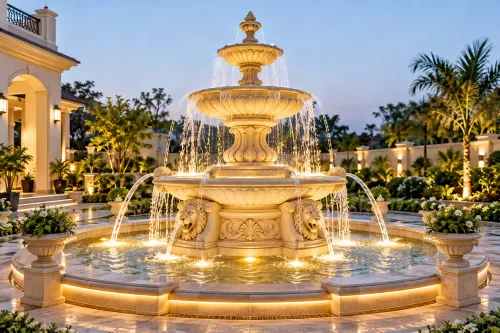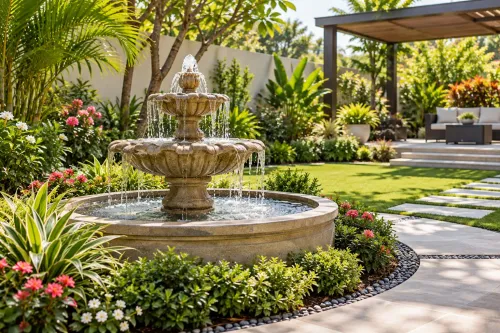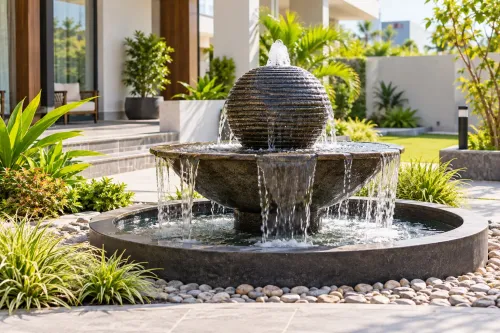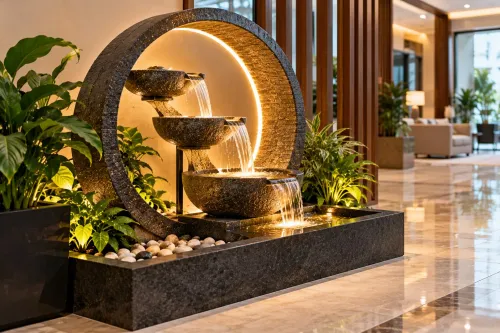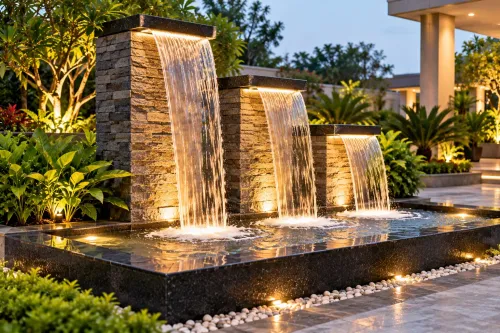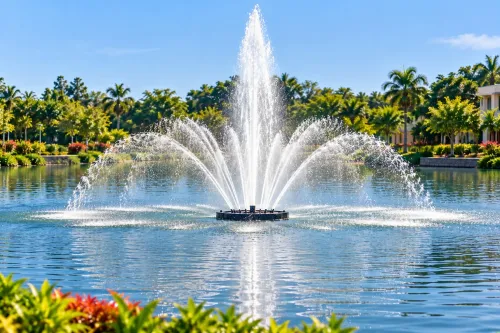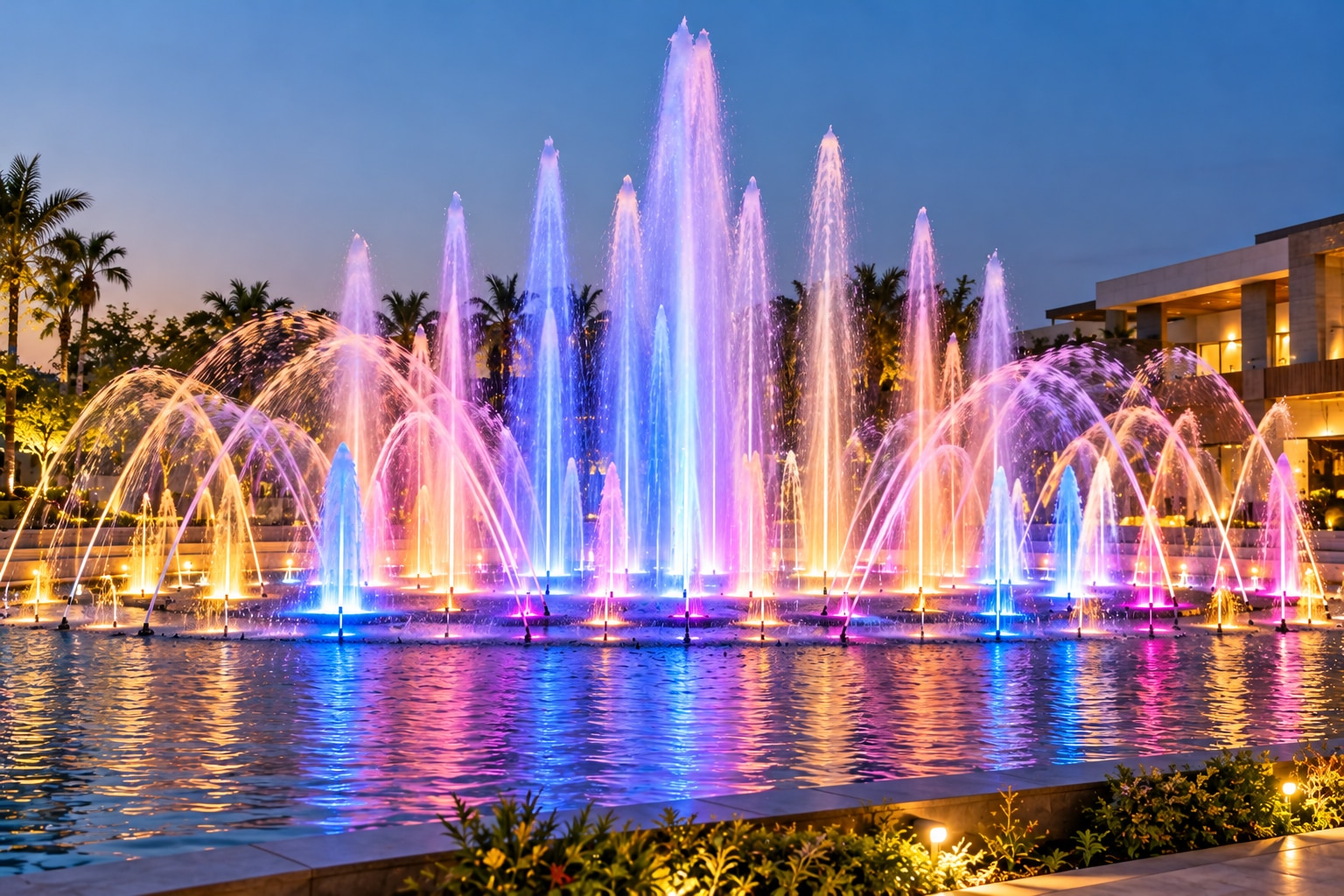
A dancing fountain is not simply a set of illuminated nozzles: it is a recirculating hydraulic, electrical, control and safety system that must perform around people and changing weather. By the end, you will know how to compare fountain types, prepare a design brief, assess site risks and demand meaningful performance tests before approval.
Key takeaways
- Use separate nozzle groups and programmed pump controls for timed movement.
- Size the basin, pumps and jets for wind, viewing distance and crowd safety.
- Include filtration, water treatment, drainage and safe maintenance access in the design.
- Test every programmed sequence, emergency stop and public-facing safety feature before opening.
How a dancing fountain creates timed water movement
A dancing fountain creates timed movement by changing water flow, jet direction, height and colour according to programmed cues. A pump draws water from the basin through filtration and sends it to a manifold, which divides the flow among separate nozzle groups.
Each nozzle produces a defined spray pattern. A nozzle valve controller opens, closes or modulates individual valves so one jet rises while another falls. Variable-speed pumps or drives can also change flow smoothly instead of switching it on and off. The lighting system synchronises colour and brightness with these water movements.
A controller stores the sequence and repeats it with consistent timing. DMX512 can carry lighting commands, but it is not a complete safety system; low-water protection, pump interlocks and emergency shutdowns belong in the control and safety circuits.
| Fountain type | How water moves | What distinguishes it |
|---|---|---|
| Static jet fountain | Continuous flow at a fixed height | Simple display with little or no timed choreography |
| Ring fountain | Jets arranged in a circle, usually with shared flow | Strong geometric form but limited individual movement |
| Musical fountain | Water and lighting cues follow music | Choreography is tied to an audio track |
| Interactive fountain | Sensors or user controls trigger jets | Movement responds to people rather than a fixed show |
| Dancing fountain | Independently timed jets, valves, pumps and lights | Repeated changes in height, sequence, colour or direction |
Unlike a static fountain, a dancing fountain needs independently controllable visual groups. That arrangement also permits a reduced show when one valve, nozzle or pump fails.
Match the fountain design to the site and audience
Choose jet height from viewing distance and wind exposure, not from a nozzle catalogue. A low, broad pattern suits close pedestrians; taller jets need a clear setback, stable wind conditions and drainage that can handle drift. Keep spray away from entrances, seating, electrical cabinets and slippery pedestrian routes.
| Site | Suitable type and arrangement | Height and nozzle guidance |
|---|---|---|
| Park | Choreographed fountain with clustered zones or a ring fountain around a central feature | Use moderate jets for changing views along paths; space nozzles so planting and benches remain outside the spray footprint |
| Hotel | Ring fountain or restrained choreographed fountain at an entrance, lobby court or pool edge | Keep jets lower near guests and vehicles; use symmetrical nozzles that preserve the arrival view from several approaches |
| Plaza | Musical fountain with a grid or multiple programmable rows | Select taller jets only when the audience stands beyond the wet zone; leave clear sightlines and provide rapid shutdown |
| Public place | Static jet fountain for dependable display, or an interactive fountain with flush floor nozzles | Match height to crowd control: low jets reduce drift and obstruction, while interactive jets need non-slip paving and controlled pressure |
A static jet fountain fits a site that values simple operation over changing scenes. A choreographed or musical fountain earns its footprint when visitors stay long enough to watch timed movement; an interactive fountain suits active participation, not a walkway that must remain dry.
Treat height as a wind-dependent performance figure. Specify the maximum acceptable wind speed, the reduction pattern above that limit and automatic shutdown conditions, because wind can bend jets, enlarge the wet area and carry treated water onto paving or equipment.
Prepare the hydraulic, electrical and civil design inputs
A supplier needs measured site data, not an artistic sketch. Submit the following before pump, nozzle, cable and structural selections are made:
1. Record basin dimensions, usable water depth, operating level, overflow level and water volume. Show the pump sump, suction screens, drainage route, make-up-water point, access covers and nearby structures on a dimensioned plan.
2. State the required jet heights, nozzle types, simultaneous operating groups and total flow. Provide pipe lengths, diameters, fittings, elevation changes and discharge points so the supplier can calculate total dynamic head rather than guess from pump labels.
3. Specify the duty standby pump arrangement, filtration, treatment equipment, operating hours and refill rate. If using ultraviolet treatment, state the validated flow, UV dose, lamp monitoring and cleaning access, plus the separate residual-disinfectant plan.
4. Provide the incoming voltage, available fault current, control-panel location, cable routes, lighting load, pump starting method and emergency-stop locations. Equipment near or inside the basin must follow the zone requirements of IEC 60364-7-702; DMX512 show data cannot replace hardwired low-water, door and pump interlocks.
5. Give the civil design loads for grilles and covers, paving slopes, drainage capacity, slip-resistant surface specification, edge details and maintenance access. Protect the make-up-water connection against backflow under EN 1717; a check valve alone is not automatically sufficient.
State each submerged product’s immersion limit, cable-gland system and installation depth, because an IP rating does not prove permanent submersion suitability.
Control water quality, wind, access and abnormal conditions
A failed low-water sensor can destroy a pump within minutes, while an unnoticed overflow can turn surrounding paving into a slip hazard. Design automatic isolation for abnormal conditions, not just attractive show sequences.
Treat the basin as a recirculating public-water system. UV treatment acts only on water passing through its reactor, so specify its dose, validated flow, lamp monitoring and cleaning access, then maintain a separate residual disinfectant strategy. Include filtration, scheduled basin and pipework cleaning, and a Legionella risk assessment covering spray devices, drains and shutdown periods.
Protect the make-up connection against backflow protection requirements under EN 1717; a check valve alone is not automatically sufficient.
Specify these operating safeguards:
- Low-level, dry-run, high-level, overflow, leak and pump-temperature protection.
- A hardwired or safety-rated emergency stop, pump interlocks, chemical alarms and access-door switches; do not rely on DMX512 show data for safety.
- Grilles and covers with suitable loading, slip-resistant paving, safe maintenance access and drainage sized for splash and overflow.
- Wind sensors or operating limits that prevent unsafe wind drift onto walkways, roads or electrical equipment.
- Enclosures and field devices with an IP rating suited to immersion, spray and cleaning methods.
Document shutdown and restart steps: isolate power, secure chemicals, drain or circulate stagnant sections, inspect filters and nozzles, and verify water quality before reopening. Use winterization where freezing threatens pipes, pumps or valves; record who authorises restart and what checks they completed.
Specify acceptance tests before opening to the public
Do not accept the fountain because every nozzle works once. Make commissioning a witnessed, signed test at defined pump flow, basin level, treatment readings and stated wind limit. Require measured results, drawings, control settings, maintenance instructions and a defects list with close-out dates.
1. Verify nozzle performance at the specified flow: jet height, throw, response time and jet uniformity across every zone. Test after filters, strainers and nozzles have run under the specified water-quality regime, not only when newly installed.
2. Run the full show through DMX512-A or the specified control system. Check choreography timing, lighting colour consistency, loss-of-communications recovery, emergency stop, safety-trip restart and low-water shutdown.
3. Conduct drainage testing at maximum flow, including overflow routes, splash collection, basin emptying and surrounding paving. Confirm covers, grilles, slip resistance and maintenance access do not create trip or entrapment hazards.
4. Demand a water balance showing evaporation, wind drift, splash-out, backwash, purge, cleaning losses and make-up water. A pump-flow figure alone cannot establish consumption.
5. Test the agreed wind response: reduced height, altered sequences or automatic shutdown at the stated wind speed. Confirm wind-blown water does not reach electrical equipment or pedestrian routes.
Use a supplier comparison sheet to record each result against the specification, including immersion ratings rather than relying on an IP code alone. Royal Fountains & Equipments - 08043694426 can be asked to provide this evidence as part of a commissioning handover, not as a substitute for witnessed testing.
Related product
 | We are instrumental in offering a high quality range of Dancing Fountains which is creatively and accurately designed by our skilled professionals. View product → |
Frequently asked questions
How does a dancing fountain create timed water movement?
A pump sends filtered basin water to a manifold, which divides flow among nozzle groups. Programmed controls vary flow, jet direction, height and lighting according to timed cues.
How should you match a dancing fountain to its site and audience?
Choose jet height, spray reach, lighting, sound and viewing layout based on the available space, sightlines, pedestrian movement, wind exposure and whether the audience is at a hotel, park or public venue.
What design inputs are needed before building a dancing fountain?
Prepare the basin dimensions, water volume, nozzle layout, pump duty, filtration, electrical load, control system, drainage, access routes and civil foundation details.
What should you test before opening a dancing fountain to the public?
Run each programmed sequence and verify jet heights, timing, lighting, water quality, drainage, wind response, emergency stops, electrical protection and safe maintenance access.