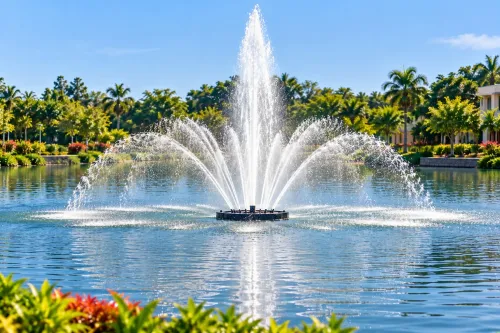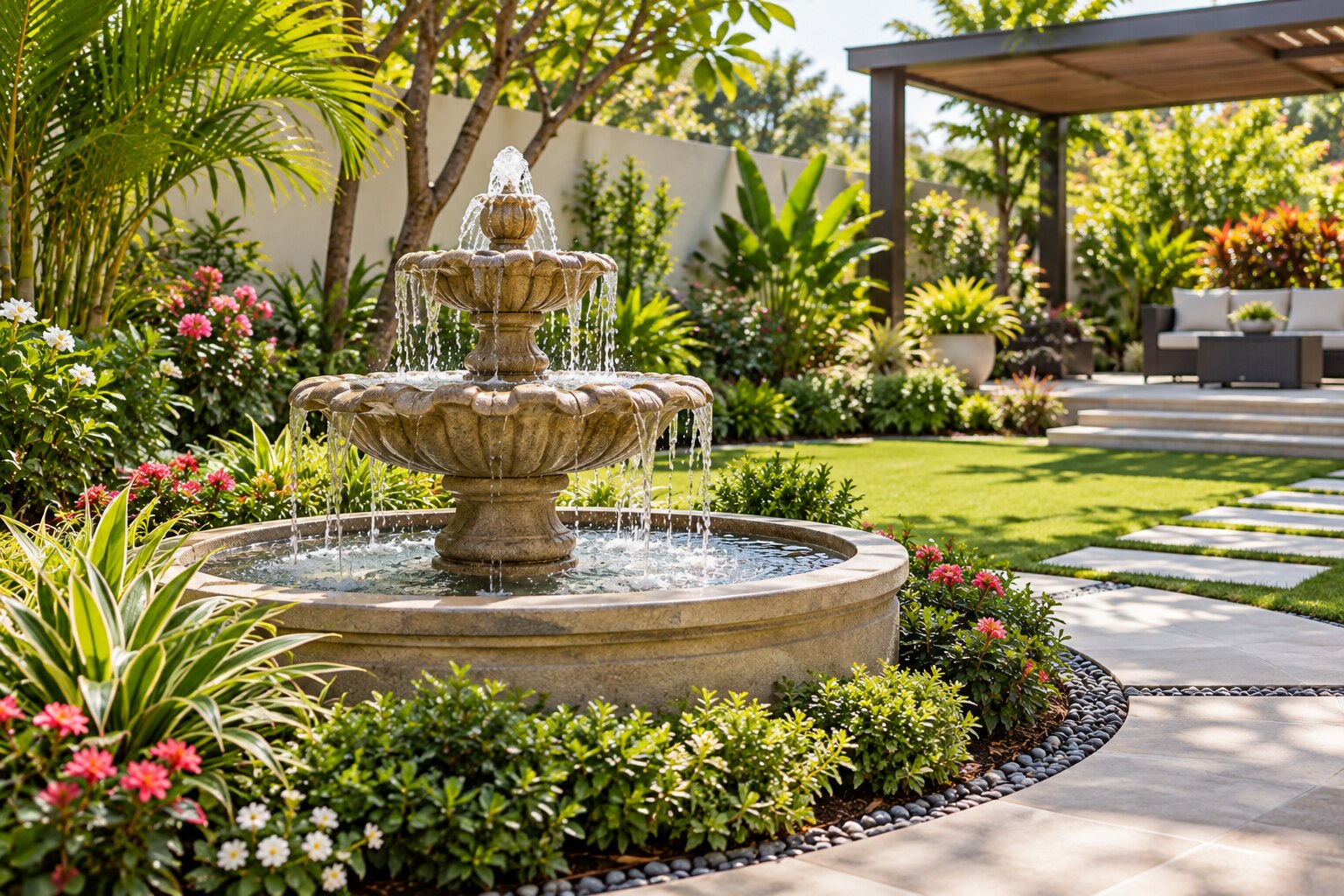
The right garden fountain depends on the space, viewing distance, wind exposure, water movement and maintenance you can support—not on appearance alone. By the end, you will be able to shortlist a fountain type, check its hydraulic and electrical specifications, and give a supplier an installation brief that prevents common failures.
Key takeaways
- Choose a tabletop fountain for balconies, courtyards and close-range seating areas.
- Check sightlines and wind before deciding on spray height or fountain placement.
- Match basin volume, pump flow and pump head to the installation.
- Specify materials, operating limits and site details before requesting a quotation.
Start with the fountain form that suits your garden
Choose the fountain by what you want the garden space to do. A tabletop fountain suits a balcony, courtyard table or seating area where you want close-range sound without sacrificing floor space.
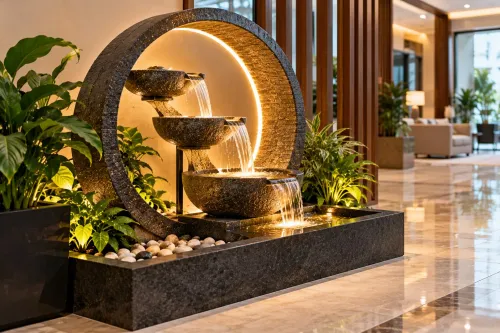
Choose a wall-mounted fountain for a narrow patio or boundary wall, but check that splashing will not stain the wall or wet nearby furniture.
| Option | Best fit | Main trade-off |
|---|---|---|
| Tabletop fountain | Small patios, balconies and intimate seating | Limited water volume and spray height |
| Wall-mounted fountain | Narrow gardens and boundary walls | Requires a strong, protected mounting surface |
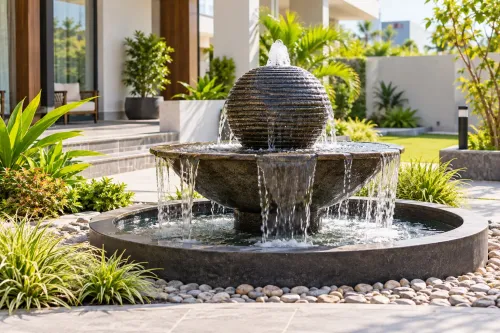
| Basin fountain | Open lawns, entry paths and central focal points | Needs circulation space around the basin |
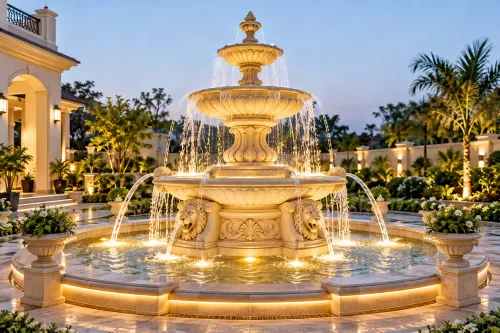
| Tiered fountain | Formal gardens and spaces viewed from several angles | More splash, cleaning and structural weight |
| Pondless fountain | Safe circulation areas where you want moving water without an open pond | The hidden reservoir still needs access for cleaning |
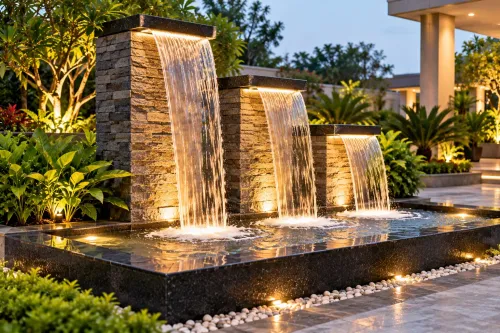
| Spillway fountain | Raised beds, retaining walls and contemporary landscapes | Water flow depends heavily on accurate level and edge construction |
Use a basin fountain when people approach from multiple directions; use a wall-mounted or spillway fountain when the garden has one dominant viewing line. A tiered fountain creates a stronger visual centre, while a pondless model keeps paths open and reduces the risk of someone falling into an exposed pool.
Leave enough clearance for chairs, pruning and access to the pump. A fountain that blocks a path or throws water into planting beds is the wrong form, regardless of its appearance.
Match the fountain to space, sightlines and wind
A fountain should be large enough to read clearly from your main viewing distance, but not so large that its spray dominates the garden area. Judge fountain size against planting beds and patio dimensions: leave walking routes clear, preserve sightlines across seating areas, and keep the feature from visually swallowing nearby plants.
Before choosing a location, check these constraints:
- Measure the available footprint, including the basin rim, access space and any cover needed for pump maintenance.
- Stand at the intended viewing distance from seating, doors and windows. Confirm that the highest spray remains visible without being hidden by shrubs, railings or furniture.
- Compare the fountain’s height and width with nearby walls, trees and planting beds. A tall plume needs more open space than a low bubbler.
- Map the prevailing wind direction. Place spray nozzles away from doors, electrical equipment, walls and slippery paving; wind-driven drift can wet paths and empty the basin.
- Check patio dimensions and circulation space so people can pass without brushing the fountain or its wet perimeter.
Do not size the basin from its catalogue capacity alone. Allow for pump submergence, spray volume, transient drawdown and splash-out, then provide makeup water and overflow control separately. Evaporation depends on exposed water, temperature, humidity and air movement; wind drift also changes with nozzle type, spray height and droplet size.
A sheltered sightline can therefore reduce maintenance as well as improve the view.
Check basin volume, pump flow and pump head
A fountain produces its intended display only when the pump delivers the nozzle’s required flow at the installed head. Select it from the system curve: the working point is where the pump curve intersects the installation’s flow-versus-head demand, not where the pump advertises its highest output.
Do not confuse pump flow rate litres per hour with maximum head height. Flow rate is the water volume delivered at a stated resistance; maximum head height is usually the shut-off point, where flow has fallen to zero.
A pump rated at 3,000 litres per hour at zero head may deliver far less through raised pipework, bends, valves, filters and a nozzle.
Calculate total dynamic head from the vertical lift plus friction in the pipe and fittings, filter resistance, valve losses and the pressure the nozzle needs for its specified spray height and pattern. Changing pipe diameter or adding a filter can shift the operating point, leaving the jet short, weak or unstable.
Size the basin for the operating water level, not its catalogue volume alone. Include pump submergence, water held in pipework, spray volume, splash-out, wind-driven drift and temporary drawdown; a tall plume can expose the intake and cause vortexing or air ingestion.
Use this check before ordering:
- Confirm the nozzle’s required flow and pressure for the target height.
- Obtain the pump curve and locate its output at the calculated total dynamic head.
- Check that basin volume keeps the pump intake submerged during operation.
- Reject any setup that relies only on the pump’s maximum head height or zero-head flow figure.
- Allow for filtration, treatment and splash losses without assuming a universal turnover rate.
Compare materials and outdoor operating limits
Choose the construction material by exposure: sunlight, freeze-thaw cycles, salt or chlorides, water-treatment chemicals, impact risk and the effort required to move or repair the fountain.
| Material | Strengths | Risks and best fit |
|---|---|---|
| poly-resin | Light, easy to position and resistant to everyday garden impact | UV ageing and brittle damage in severe cold; seal joints and provide winter storage where freezing is severe |
| fibreglass | Lightweight with good moisture resistance and straightforward repairs | Surface damage can expose the laminate; suitable for sheltered or moderate-exposure installations |
| stone powder | Moulded detail at lower weight than solid stone | Check the sealer and freeze-thaw rating; trapped water can split the casting |
| natural stone | Heavy, stable and visually durable | Porosity, staining and mineral compatibility vary by stone; use a sealed, frost-rated grade |
| concrete | Strong and resistant to movement | Porous concrete absorbs water, expands when frozen and can leach alkalinity; specify a sealed, frost-resistant basin |
Metal parts need equal attention. Dissimilar submerged metals can create galvanic corrosion, while chloride-rich water can pit stainless alloys inside joints and crevices. Match the treatment chemical to the basin, seals, metals, discharge rules and any wildlife or public-contact limits.
Specify these protections before approval:
- Use equipment listed for the installation’s wet location and outdoor conditions.
- Confirm bonding, grounding, receptacles and ground-fault protection meet the electrical code adopted at the site.
- Do not substitute an indoor pump inside a weatherproof box.
- Plan winterization: drain bowls, piping, valves, filters and pump housings, then remove components that can crack from trapped ice.
A fountain in a hot, stagnant basin also needs circulation and algae control; low pH or excess disinfectant can shorten equipment life.
Turn your shortlist into an installation-ready specification
Before you approve the order, get a written specification that matches your site, water display and maintenance plan—not just a catalogue model.
1. Ask for the pump’s operating point on the system curve: required flow at total dynamic head, including elevation, pipe and fitting friction, valves, filters and nozzle pressure. A pump’s maximum flow at zero head does not predict installed performance. Confirm the nozzle’s flow, pressure, height and pattern requirements.
2. Confirm the construction materials for every submerged and exposed part. Ask how stainless steel and brass will be isolated where dissimilar metals could create galvanic corrosion, and whether chloride-rich water, treatment chemicals and crevices could cause pitting. Request care instructions for each alloy.
3. State that the fountain is for outdoor use and ultraviolet exposure, then confirm the ratings for the pump, cables, lights, junctions, controls and finishes. Get the permitted duty cycle in writing, including whether continuous operation is allowed and what service access the installation needs.
4. Have the installer identify the electrical code adopted at your site, the equipment listing, bonding and grounding method, receptacle location, and ground-fault protection. An indoor pump inside a weatherproof box does not replace wet-location compliance.
5. Confirm separate provisions for evaporation and wind-driven splash: makeup-water connection, overflow route and drain. If freezing is possible, require a winterization procedure covering bowls, pipes, valves, filters and pump housings.
Royal Fountains & Equipments - 08043694426 can use these details to prepare a site-specific specification rather than treating a decorative model as installation-ready.
Related products
 | Table Top Fountains this fountain perfectly crafted with combination of durable poly resin, stone powder and fiber glass for lasting quality creates a realistic, natural... View product → |
 | / garden fountain : this beautiful fountains are the most pleasant sight for your eyes, ears & of course for your soul too. View product → |
Frequently asked questions
Which fountain form suits a small garden or balcony?
A tabletop fountain suits a balcony, courtyard table or seating area when you want close-range water sound without using floor space.
What should you check before placing a fountain outdoors?
Check the available space, viewing angles, water-splash zone and local wind conditions before choosing the fountain and its position.
How do basin volume, pump flow and pump head affect fountain selection?
Basin volume affects water capacity, while pump flow and pump head determine whether the pump can deliver the required water movement and height.
What should an installation-ready fountain specification include?
Include the fountain form, dimensions, basin volume, pump flow, pump head, material, outdoor operating limits, placement and sightline requirements.