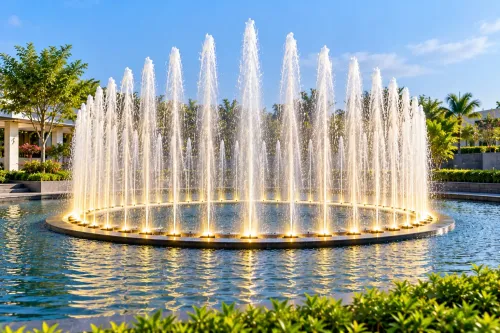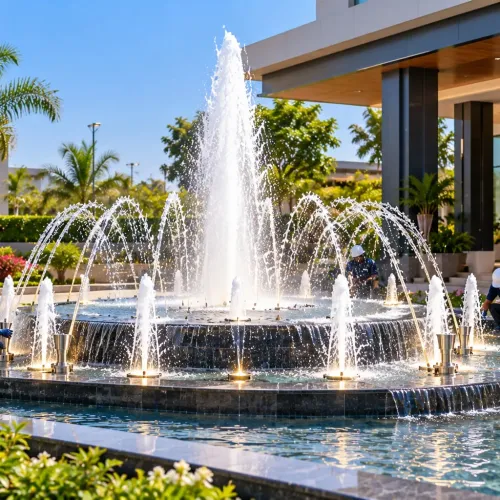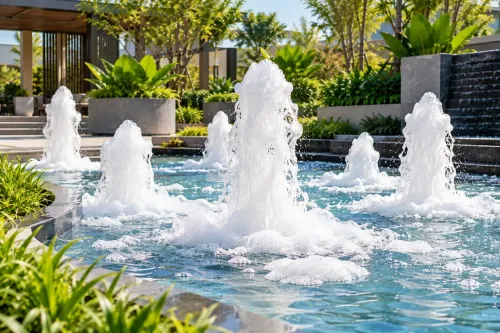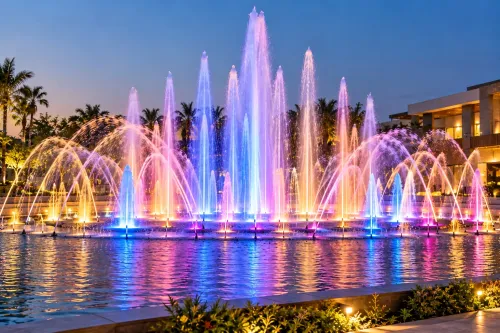
A clear needle jet, white foam column, umbrella-shaped bell and wind-sensitive mist all come from different nozzle geometries and hydraulic conditions. By comparing the visible effect with its flow, pressure, filtration, installation and site requirements, you can choose a nozzle that performs predictably rather than selecting one by appearance alone.
Key takeaways
- Use jet nozzles for height, aerating nozzles for white foamy columns.
- Choose nozzle geometry after confirming flow rate, pressure and pump capacity.
- Install fine-spray nozzles only with effective filtration and clean water.
- Select adjustable nozzles when wind, splash and changing effects matter.
Which fountain nozzle creates each visible water effect?
Identify the visible effect first, then choose the nozzle: geometry determines whether water stays coherent, spreads into a plane, forms a film, or carries entrained air.
| Nozzle type | What it looks like from a distance | Architectural lighting result |
|---|---|---|
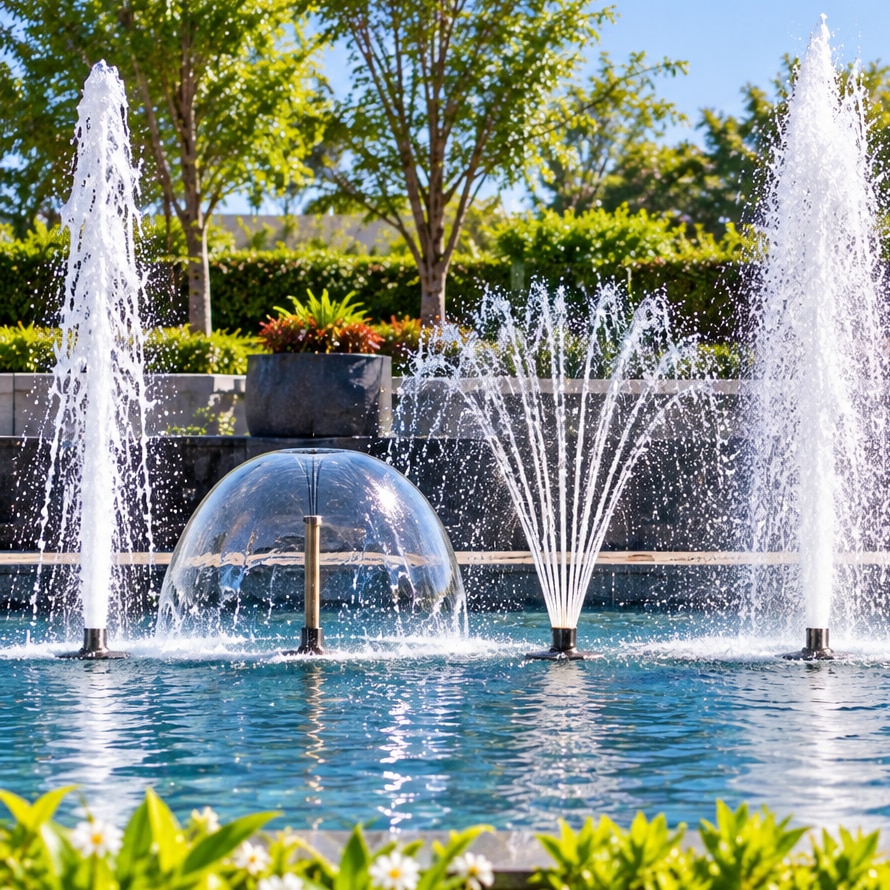
| Laminar jet | Clear needle or glass-like arc with sharp edges | Crisp edge lighting and long optical continuity |
| Aerated foam jet or geyser | Fuller white or frothy column, mist and stronger sound | Bubbles scatter light through the plume, making it brighter and whiter |
| Cascade nozzle | Falling curtain with broken, layered movement | Broad illuminated texture across the drop |
| Sheet nozzle | Wide, thin plane of falling water | A glowing architectural screen; edges break up visibly |
| Fan nozzle | Thin triangular or radial fan | A sharp lit wedge or spreading beam |
| Mushroom or waterbell nozzle | Even umbrella or bell-shaped film | A continuous glowing rim when the deflector stays level |
| Ring nozzle | Circular line of separate outlets | A luminous ring or repeated points |
| Bubbling nozzle | Coarse rising bubbles and clustered turbulence | Bright, sparkling volume without optical continuity |
| Multi-jet, crown or trumpet arrangement | Symmetrical spray, crown or grouped cluster | Repeated highlights expose uneven spacing or height |
An aerated foam jet adds air through an air-inducing chamber, perforated insert or restricted outlet. A divider, deflector or manifold only redirects or splits water; a white plume therefore proves visual aeration, not pond oxygen-transfer performance.
Specify light placement with the nozzle effect. Clear jets sharpen edges, while bubbles scatter light throughout the plume.
How does nozzle geometry change height, spread, sound and splash?
Outlet geometry sets height, spread, sound and splash. A small, smooth outlet can produce a narrow, tall stream, but an elbow immediately upstream, unstable pressure, a partly closed valve or entrained air can turn that laminar jet into pulses.
A waterbell nozzle needs a level mount, clean deflector edge and even annular film; scale or uneven inlet pressure creates streaks or a lopsided bell that extra pump pressure cannot repair.
| Nozzle or arrangement | Geometry and flow | Physical behaviour |
|---|---|---|
| Mushroom nozzle or waterbell nozzle | Deflector spreads an annular film | Broad, quiet umbrella; defects show as streaks or asymmetry |
| Fan nozzle or sheet nozzle | Thin, exposed plane of water | Wide visual spread, louder edge breakup, more splash and mineral deposits |
| Aerated or fine-droplet outlet | Air inlet or restricted passage adds air | Whiter, louder effect with greater drift; fine droplets are highly wind-sensitive |
| Ring nozzle | Multiple outlets around a circle | Even circular spray only when outlets share pressure and alignment |
| Multi-jet or crown pattern | Several branches divide one supply | Different branch lengths or fittings produce unequal jet heights |
Air inlets add air; dividers, deflectors and manifolds only redirect or split water. Aerated effects contain bubbles, while fine droplets carry more exposed surface, so both sound louder and drift further than solid jets.
A submerged outlet is not equivalent to a surface-emerging outlet: water above it consumes pressure and softens the effect. Performance data must state whether discharge enters air or occurs below the operating water level.
How should you match a nozzle to flow, pressure and pump capacity?
A pump's motor horsepower does not tell you the jet height or flow rate. For a vertical jet, check H = v²/(2g): 1 bar gives about 14 m/s velocity and a theoretical 10 m rise before nozzle losses, air drag and breakup.
Compare the catalogue height at its stated flow and pressure with the pump's operating point at the nozzle inlet.
| Nozzle type | Hydraulic implication | What to compare |
|---|---|---|
| Laminar | Low turbulence, fine filtration | Stable pressure and nozzle orifice diameter |
| Aerating or foam | Air chamber and internal restriction add losses | Required pressure, flow rate and water-level range |
| Deflector or waterbell | Deflector geometry controls spread | Inlet pressure and even annular flow |
| Multi-jet or ring | Manifold divides the discharge | Branch flow, pipe diameter and nozzle count |
Add static lift, pipe and fitting friction, valve losses and required nozzle pressure to the system head. A pump rated for the target flow at zero head can deliver far less at the installed head.
Read the pump curve by locating its intersection with the system head curve, then verify that the resulting flow divides correctly among every outlet. Relate nozzle size and outlet diameter to pump discharge, pipe diameter and the number of nozzles operating together.
Use a flow-control valve to balance branches, not to rescue an incorrectly selected pump. A larger-looking orifice does not reliably mean higher consumption because aerating, deflector and multi-jet nozzles impose different internal losses. Specify the operating range: foam appearance changes with basin water level and backpressure, so one showroom condition is not enough.
What filtration and installation conditions does each nozzle need?
1. Ask for the nozzle’s required filter mesh; do not assume the pump strainer is fine enough. Laminar nozzles need cleaner water and finer, nozzle-specific filtration than open aerating or cascade nozzles. Install a strainer or separate filter before the nozzle inlet.
2. Protect clear jets from turbulence. Use a stiller chamber or straight pipe run where the nozzle needs stable differential pressure, and keep elbows, sudden reducers, air leaks and partially closed valves away from the inlet. Mount waterbell nozzles level and clean the deflector edge; scale or a tilted surface creates a streaked, uneven bell.
3. Check the operating water level before installation. For shallow basins, verify minimum starting depth, submerged clearance and backpressure because foam and geyser effects change as the level moves. In ponds, treat visual aeration separately from oxygen-transfer duty; a white plume does not prove a measured oxygenation result.
4. Check the surrounding site, not only the nozzle. In plazas and pools, calculate clearance from edges, pedestrians and wet-slip zones, then provide splash containment outside the basin. Floating units need a stable platform, flexible connections and movement allowance; indoor displays need a drain-safe splash envelope, humidity control and protected lighting and electrical equipment.
Test fine-droplet effects in the site’s actual wind, since a still-air showroom result hides drift.
Which nozzle is the practical choice for your site and design brief?
Choose the nozzle by matching the visual effect to the site’s operating limits, not by selecting the tallest catalogue photograph.
| Option | Best fit | Acceptable trade-off |
|---|---|---|
| Laminar jet | Indoor fountain, swimming pools and precise lighting | Needs fine filtration, clean water and stable pressure |
| Foam or geyser | Shallow basin or public plaza fountain needing a white, full plume | More noise, spray, wind sensitivity and water-level variation |
| Sheet, fan or waterbell | Architectural planes, fans and umbrella forms | Requires room for splash, edge breakup and mineral deposits |
| Bubbling or coarse aerating | Ponds and informal clusters | Gives turbulence rather than a solid, optically continuous stream |
| Ring, crown or multi-jet | Symmetrical layouts | Needs equal branch flow, outlet elevation and alignment |
A floating fountain suits a lake or large pond only after you allow for platform movement, flexible connections, wind drift and changing water level. Treat visual aeration as separate from oxygen-transfer performance.
Before ordering, request a performance table stating:
- Flow, pressure and jet height
- Nozzle inlet size and pipe connection
- Required filter mesh and minimum water depth
- Whether testing discharged into air or below the operating water level
Royal Fountains & Equipments - 08043694426 can use those figures, along with basin dimensions, lighting positions and the pump operating point, to specify a complete installed result rather than match a nozzle to horsepower alone.
Related products
 | Fountain Nozzle The Fountain Nozzle is major part of the system that determines the overall pattern of the fountain. View product → |
 | A column of Frothy, aerated water, Recommended for small and medium displays in shallow pools. Beautiful when lighted. View product → |
Frequently asked questions
Which fountain nozzle creates each visible water effect?
Jet nozzles create coherent vertical streams, fan nozzles form flat sheets, cascade nozzles produce films or curtains, and aerating nozzles create white, foamy columns by mixing air with water.
How does nozzle geometry change height, spread, sound and splash?
A narrow outlet concentrates water into greater height, while wider outlets spread it into fans, sheets or films. Air-entraining geometry increases whiteness and sound; wider sprays increase wind drift and splash.
How should you match a nozzle to flow, pressure and pump capacity?
Check the nozzle manufacturer’s flow and pressure chart, then select a pump that delivers the required flow at the system’s total dynamic head, including pipe, valve and filter losses.
What filtration and installation conditions does each nozzle need?
Fine-spray and laminar nozzles need clean, well-filtered water and protected outlets. Provide stable mounting, accessible strainers, suitable pipe sizing and enough clearance to contain splash.
Related products
 | Flower Jet with Ring Fountains Flower Jet with Ring Fountains Flower Jet with Ring Fountains are one of the developed version of decorative fountains. They can be single stage or double stage. View product → |
 | Foam Jets with Ring Fountain We are one of the leading providers of high quality FoamRing Fountains, which enhance ambiance of the garden. View product → |