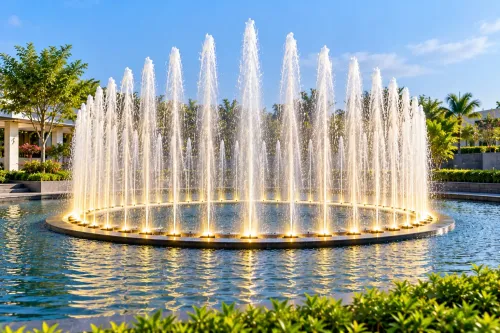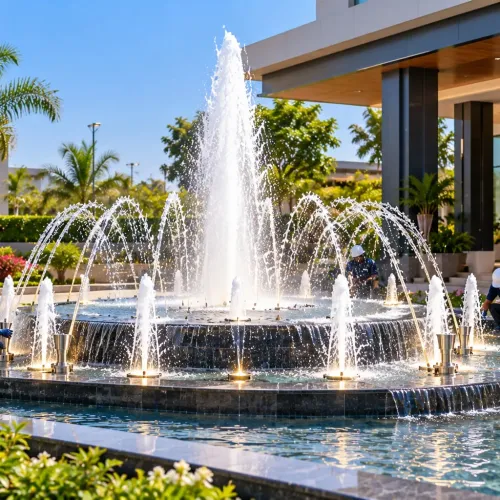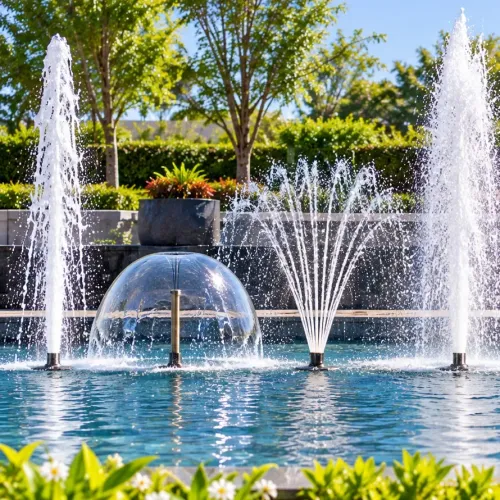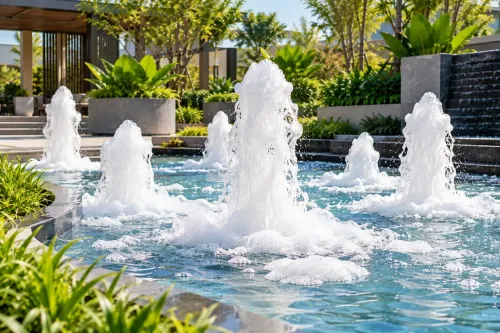
Choosing a fountain for a public venue requires more than matching lights and jets to a playlist. You need to compare water-feature formats, reserve the right space, specify hydraulic and control systems, and plan for water quality, weather, maintenance and public safety before construction begins.
Key takeaways
- Match fountain scale to viewing distance, audience behaviour and operating hours.
- Reserve equipment rooms, drainage, access routes and safety zones before basin design.
- Coordinate jet types, pump capacity, lighting and music control as one system.
- Specify wind limits, water treatment, fault protection and cleaning access in writing.
Choose the Fountain Format for the Site and Audience
Choose the format by matching audience behaviour, viewing distance, operating hours and maintenance capacity—not by choosing the most dramatic jet.
| Option | What it means | When it applies |
|---|---|---|
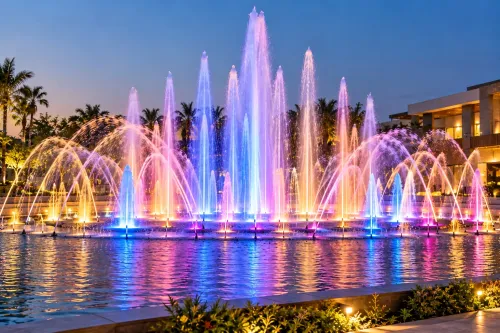
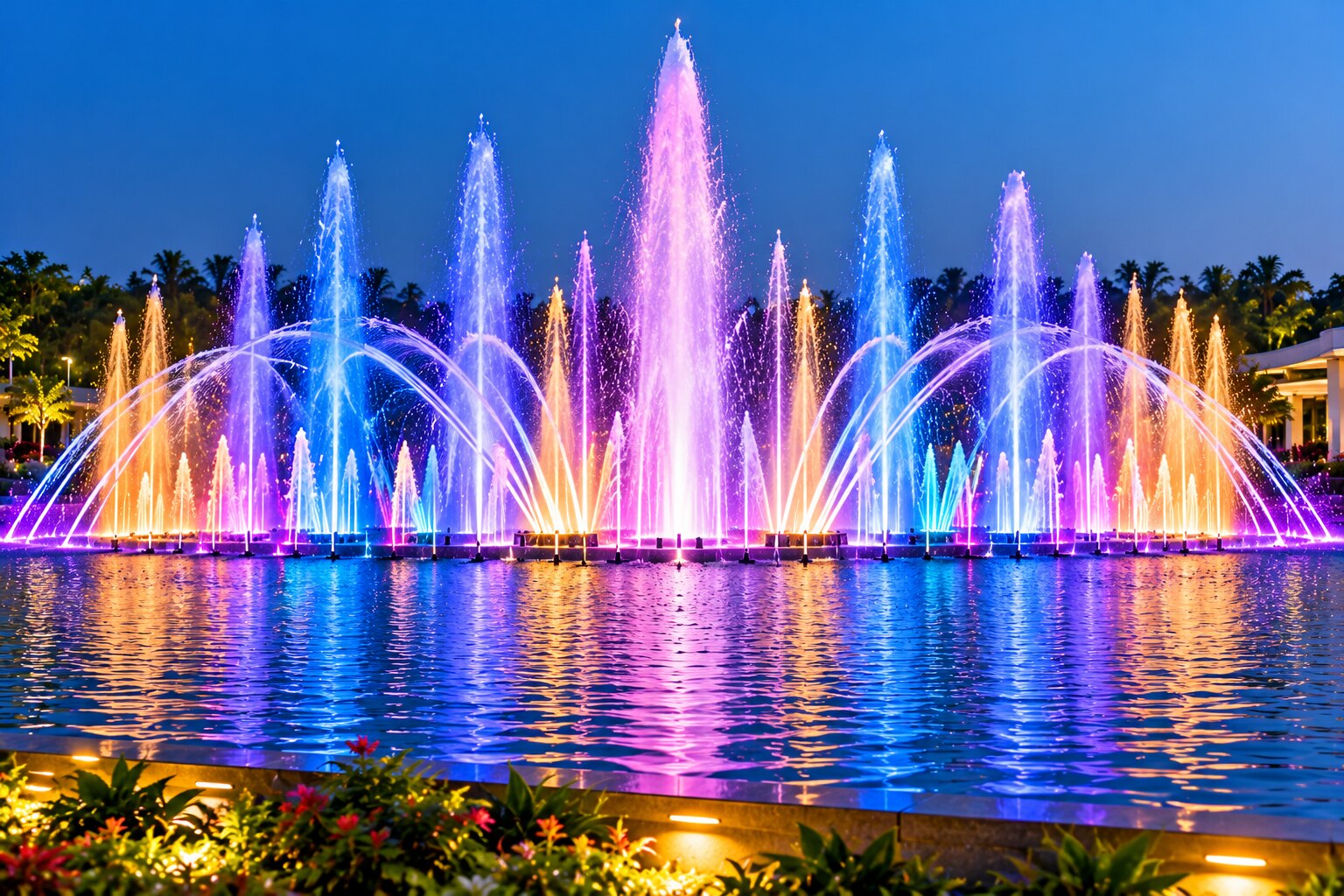
| Musical dancing fountain | Computer-controlled jets, lights and audio create timed choreography. | Choose it for festivals, malls, hotels and civic venues where programmed shows justify pumps, controls, speakers and regular servicing. |
| Conventional show fountain | Fixed or repeating jet patterns provide visual impact without music-led choreography. | Use it where visitors watch from a defined edge and the operator wants simpler programming and fewer audio dependencies. |
| Dry deck fountain | No open basin sits above the paving; recessed nozzles spray through flush grilles or slots. | Select it for plazas and play-adjacent spaces that need clear pedestrian movement, but specify slip-resistant paving, drainage and isolation of maintenance zones. |
| Interactive fountain | Sensors or push controls let visitors trigger jets, lights or sequences. | Use it for family venues when supervision, hygiene, anti-slip surfaces and rapid shutdown matter. |
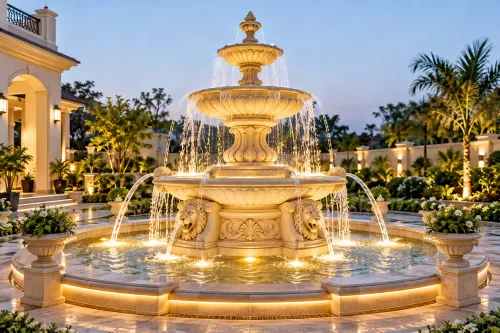
| Static water feature | A cascade, wall, rill or still pool runs as an architectural element rather than a timed show. | Choose it for entrances, courtyards and calming landscapes where low spectacle and quieter operation are the priority. |
A musical dancing fountain needs a clear viewing area and a control system that remains reliable during repeated shows. A dry deck fountain needs exceptional drainage; ponding turns a pedestrian attraction into a slip hazard.
For any public installation, plan water treatment, cleaning and maintenance records. Keep accessible routes clear of spray, hoses and abrupt basin edges.
Reserve the Full Footprint Before You Design the Basin
A basin that fits the jets can still fail if spectators, service access and drainage are treated as leftover space. Reserve the fountain pool size, equipment room, viewing zone and circulation routes on the site plan before fixing the basin shape or depth.
1. Measure the buildable footprint, existing levels, wind exposure and audience distance. Mark the pool’s length, width, operating depth, overflow edge and a spectator clearance that keeps spray off the nearest route and seating.
2. Allocate an equipment room beside the pool, above flood level where possible, with space for pumps, filters, valves, control panels and safe maintenance access. Record the water source, make-up line, electrical load, isolation switches and cable routes; fountain equipment needs bonding, grounding and ground-fault protection under the adopted electrical code.
3. Draw fountain drainage to a lawful discharge point, including floor drains, overflow, pool emptying and wash-down water. Confirm local plumbing, public-health and discharge rules; the CDC Model Aquatic Health Code is a technical reference, not automatically the governing law.
4. Keep accessible routes clear of hoses, spray and abrupt basin edges. Reserve stable access to the equipment room and controls, plus a dry location for the sound system and controller.
5. Document control-cable paths, DMX512-A universe locations, termination points and a safe fallback when the signal fails. Show operating hours and wind limits so the layout does not send spray onto roads, electrical equipment or pedestrians.
Specify Jets, Pumps and Music-Controlled Choreography Together
Specify fountain jet quantity from the choreography, not from the basin’s visual capacity. Each simultaneous cue needs a hydraulic budget, because opening several high-flow effects can pull the pump operating point down and make nearby jets sag.
- Group jets into hydraulic zones when they share a pump, and stage high-demand cues instead of opening every nozzle at once.
- Base fountain pump sizing on required flow and pressure at the nozzle, including pipe friction, fittings, valves, elevation and a reserve margin. A pump chosen only for total litres per minute may not deliver the velocity required for the planned height; jet height follows approximately H = v²/(2g) before system losses.
- Give each independently choreographed effect its own valve, pump or pre-engineered nozzle group. A variable-frequency drive changes overall speed or height, but it cannot position each nozzle rapidly and independently.
Use DMX512-A for lighting and theatrical-style effects, with documented universe addresses, termination and a defined safe state if communication fails. One DMX universe carries 512 one-byte channels, so count every valve, dimmer and effect channel before deciding whether additional universes are needed.
Use timecoded playback for repeatable shows. MIDI fountain control can trigger cues and tempo-linked events, while audio analysis reacts to live sound but produces less consistent patterns. Align the music timeline, valve response time and pump ramp time during commissioning; otherwise a cue may arrive before the water reaches height.
Confirm public-performance and sound-recording rights separately from the control purchase.
Plan for Wind, Faults, Water Quality and Routine Cleaning
Automatic interlocks keep a public fountain safe and presentable as conditions change: reduce jet height in high wind, shut down on low water, and isolate failed equipment before it damages pumps or sprays spectators. Put these responses in the control logic, not in an operator’s memory.
- Install a fountain wind sensor with staged responses: trim height first, then stop exposed effects when spray reaches walkways or nearby roads.
- Fit low-level probes, flow switches and dry-run protection. A falling basin level can leave a pump drawing air, causing seal damage and unstable jet patterns.
- Detect fountain pump failure through pressure, flow or current monitoring. Switch to a safe output, close the affected isolation valve and display an alarm for the operator.
- Specify fountain filtration with accessible strainers and a cleaning schedule. Fine laminar jets and clear streams show blocked or scaled orifices quickly, so remove and inspect nozzle inserts rather than merely increasing pump speed.
- Operate a documented Legionella water management program covering source water, stagnant areas, temperature, disinfection, cleaning, sampling or response triggers, and maintenance records.
Use the CDC Model Aquatic Health Code as a technical reference for circulation, filtration and disinfection, then confirm local public-health, plumbing, building and discharge rules. Keep accessible routes clear of spray and hoses, use slip-resistant drainage, and record every chemical check, filter clean, nozzle inspection and shutdown response.
Turn the Design Into a Safe, Serviceable Purchase Specification
Put acceptance criteria in the purchase specification, not in a commissioning conversation. Ask the project engineer, local authority and supplier to sign off these four areas:
| Area | Confirm before ordering | Evidence to require |
|---|---|---|
| Electrical | Fountain electrical safety, bonding, grounding, residual-current protection, isolation and cable routing; specify wet-location equipment rather than relying on an IP rating. | Single-line diagram, load schedule, protection settings, installation instructions and inspection access. NEC Article 680 applies where adopted; confirm the local code. |
| Accessibility | Clear accessible routes, stable access to controls and plant, slip-resistant wet paving, drainage, and no spray or hoses across walking surfaces. | Route drawings checked against the 2010 ADA Standards or the locally adopted accessibility code. |
| Maintenance | Isolation valves, accessible strainers, drain-down points, replaceable nozzle inserts, labelled cables and control addresses, manual local control, and a safe output after controller, network or sensor failure. | Public fountain maintenance schedule, spare-parts list, cleaning procedure and response times. |
| Music rights | Clear public-performance rights for the musical work and, if used, the sound recording. Buying a track or consumer streaming subscription is not clearance. | Written licence records naming the venue, territory, term and recordings. |
Require water-quality, discharge, warranty and training documents as well. Royal Fountains & Equipments - 08043694426 can be asked to identify which components are replaceable without dismantling finished paving and to provide the final wiring and control-address schedule. Ask who owns each approval before placing the order.
Related products
 | We are instrumental in offering a high quality range of Dancing Fountains which is creatively and accurately designed by our skilled professionals. View product → |
 | Musical Fountain Musical fountains are the center of attraction and it can be operated as a show fountain. View product → |
Frequently asked questions
How do you choose a musical dancing fountain format?
Match the format to audience behaviour, viewing distance, operating hours and the maintenance capacity available at the site.
What space must be reserved before designing the fountain basin?
Reserve the basin, equipment room, drainage, electrical controls, service access, safety clearances and spectator circulation routes.
How should jets, pumps and music-controlled choreography be specified?
Specify jet types, pump duty, flow requirements, lighting, control hardware and music synchronisation together so the system performs as one design.
What operational risks must a public musical fountain address?
Plan for wind, pump or control faults, water quality, slip hazards, drainage and routine cleaning before approving the design.
What belongs in a fountain purchase specification?
List performance requirements, materials, controls, safety features, service access, cleaning procedures, testing and handover documents.